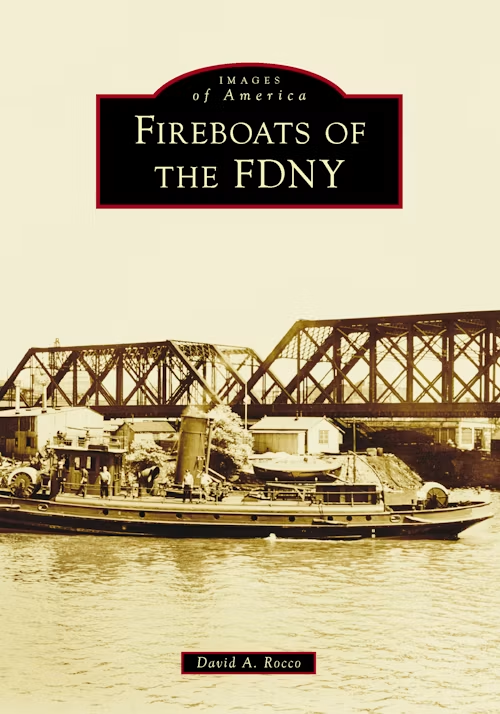
Fireboats are specialized watercraft designed for extinguishing fires on ships, piers and structures that are located along waterfronts. To this day they are used in a variety of situations: rescue and recovery operations, transportation for first responders and civilians, and in some cases, as icebreakers.
Early fireboats were known as fire floats. Toward the end of the 19th century, New York City used two forms of waterfront firefighting: a New York Police Department boat that had limited firefighting apparatus, followed by the use of commercial tugboats that also had minimal firefighting equipment.
In 1875, the Fire Department of New York (FDNY) purchased its first fireboat. When the City of Greater New York was established in 1898, the FDNY inherited the City of Brooklyn’s two fireboats. The consolidation of the five boroughs made the FDNY responsible for over five hundred miles of shorelines and waterfronts. The FDNY was also obligated to protect the northern New Jersey waterfronts as well. By 1909, NYC was considered the busiest port in the world. By this time the FDNY had ten fireboats in their fleet.
The credit for growth of the FDNY Marine Division goes to the visionary Edward F. Croker, Chief of the Fire Department of New York. Croker’s unrelenting determination helped the FDNY Marine Division become the first in the United States. The FDNY Marine Division also patrolled the NY/NJ harbor around the clock during both World Wars.
The FDNY Marine Division responded to a great number of major incidents throughout the 20th century. The General Slocum ship fire tragedy in 1904, the Luckenbach Pier 35 explosion in 1956, and the Sea Witch/Esso Brussels collision in 1973 are just a few examples where the FDNY fireboats were called upon to handle significant incidents. The many pier fires that occurred during the second half of the 20th century also kept the FDNY fireboat unit busy as well. Beginning at the start of the 21st century, the FDNY fireboats played important roles during the terrorist attacks on September 11, 2001. Eight years later, the FDNY fireboats also participated in the rescue efforts of the passengers and crew members of Captain Chesley Sullenberger’s US Airways Flight 1549—the ‘Miracle on the Hudson.’
David Rocco has been involved as a volunteer for many cultural and environmental initiatives in the Hudson Valley and NYC. He played a seminal role in the successful development and success of the Walkway Over the Hudson project. He served in several roles in other projects as well. David also co-authored a book about Navy legend Dixie Kiefer entitled The Indestructible Man.