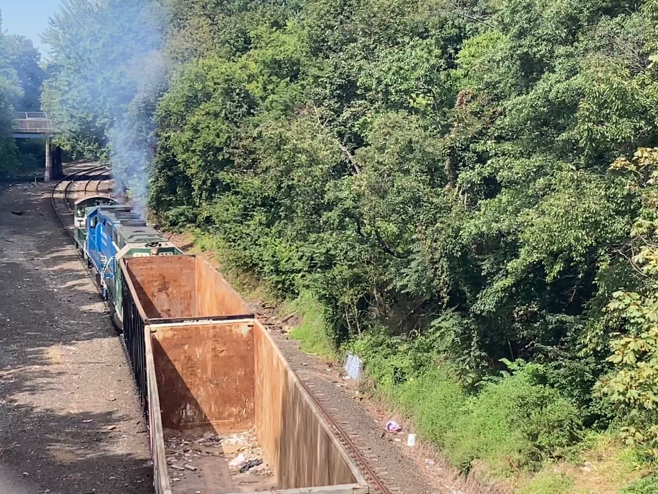
Since 2009, Civics United for Railroad Environmental Solutions has worked with civics — including the Juniper Park Civic Association — and elected officials from all levels of government to containerize waste-by-rail and eliminate dangerous diesel locomotive emissions. Starting in 2013, Assembly Member Andrew Hevesi led a successful campaign for $30M in NYS Legislative funding to replace old, high-polluting diesel locomotives with modern Tier 4 or cleaner locomotives. In 2023, Senator Joe Addabbo and Assembly Member Rajkumar led a successful campaign for a law to contain waste in rail cars. And yet rail cars of construction and demolition debris residue are still emitting toxic waste blow-off, leachate, and gas, and old diesel locomotives are still spewing toxic pollution into the air our children and grandchildren are breathing.
What is being done to contain waste in rail cars?
After the NYS law was passed to contain waste in rail cars and the Governor signed it in 2023, the law was supposed to go into effect in January 2024. However, the American Association of Railroads, American Short Line Rail Road Association, and National Waste & Recycling Organization-New York State Chapter went to federal court to fight this modest public protection. CURES is pleased to report that the NYS Attorney General and Department of Environmental Conservation are fighting in court to enforce this law. The case is scheduled to be heard in the Southern District of New York in 2026 [Case No. 24-CV-135 (RA)].
However, this NYS case could be in court for years, so CURES is also pleased to report that Congress Member Nydia Velázquez has proposed a federal approach to ending pollution from waste-by-rail. She has called for, “sealed and secure transport of dangerous waste materials such as sewage sludge, demolition debris, coal ash, and incinerator ash,” because,”While these materials are often labeled ‘non-hazardous’ under current rail regulations, they are hauled by rail and can contain highly toxic substances like arsenic, mercury, lead, and asbestos.” Today demolition debris and coal ash are hauled through Queens Community District 5 and other NYC neighborhoods by the New York & Atlantic Railway and CSX. The Congress Member’s proposal would require “all railcars carrying these waste streams to use solid covers and sealed containers and would prohibit open drains or other openings that allow liquid waste to escape.” Now we will see if the current Congress and Administration will enact these modest rules. The Long Island Rail Road, New York & Atlantic Railway, and CSX also could stop this pollution at any time with operating rules and/or tariffs, or their customers could stop it by simply using rail cars that completely contain waste. However, the MTA-LIRR and these businesses are still choosing to harm our families instead.
What is being done to replace old locomotives with Tier 4 – the EPA emissions standard for the past 10 years – or cleaner locomotives? Congress Member Velázquez is proposing to “electrify polluting railyards, and improve safety at crossings,” and “…the creation of a new pilot program at the Federal Railroad Administration to support the development of flexible train designs that can operate across multiple power sources. This would include battery-powered, electric, hydrogen, and diesel trains, helping rail systems transition toward cleaner, more efficient operations.” However, even if there were more federal funding, to the best of CURES’ knowledge the LIRR has never applied for federal DERA or CRISI funding to leverage the funding for modern freight locomotives that LIRR received from the NYS Legislature.
In CURES’ recent comments on the New York Metropolitan Transportation Council’s Regional Transportation Plan update, Moving Forward 2055, CURES pointed out that “there are funds from the NYS Legislature that accumulated since 2013, which can be leveraged with private and federal funding to re-power freight locomotives operating in the MTA-LIRR right of way to Tier 4 or cleaner emissions standards, giving communities and workers cleaner air to breathe. Frames from locomotives already owned by the LIRR (e.g., MP-15s) can be used for this re-powering, as Class 1 railroads are doing, making the money go farther. The funds are in NYS Comptroller’s Contract # DR36644. MTA has procured Dual Mode Tier 4-electric passenger locomotives. Re-powering the freight fleet also is overdue.”
The response CURES received to our public comment is the same one that the MTA-LIRR has been giving for the past 7 years – since they issued the RFP for the freight locomotive procurement in the winter of 2018. And to add insult to injury, now they also are stonewalling on an answer to why they are not making companies contain waste in rail cars to protect residents and workers. And they say, in effect, that they don’t plan to ask for private cost sharing or apply for federal funds. So here was MTA-LIRR’s response: “MTA/LIRR is engaged in an active procurement to upgrade both the LIRR work locomotive fleet and locomotives used by LIRR’s freight operator, New York & Atlantic Railway (NYAR) to Tier IV (sic) standards. Upgraded NYAR locomotives will be supported by New York State-allocated funding. Freight on the LIRR network is required to be transported in accordance with all applicable laws and regulations. As the regulations referenced in the comment are either proposed or the subject of ongoing litigation, MTA/LIRR cannot respond at this time.”
To be continued…