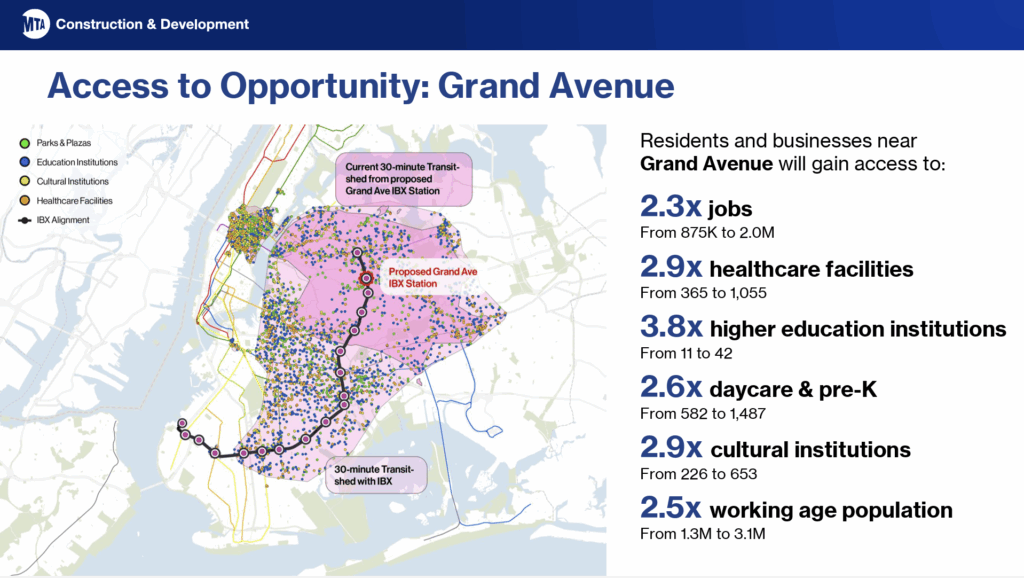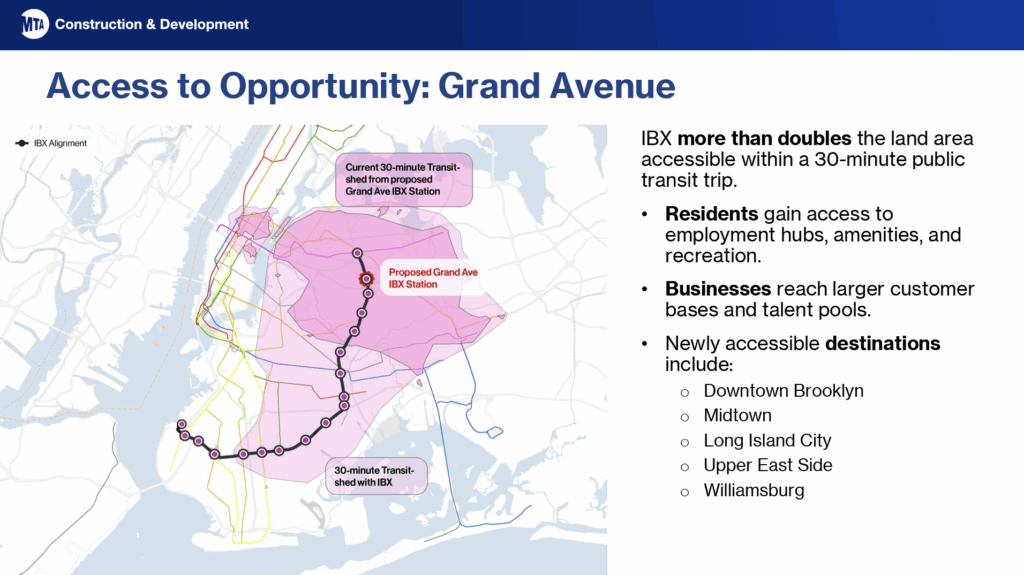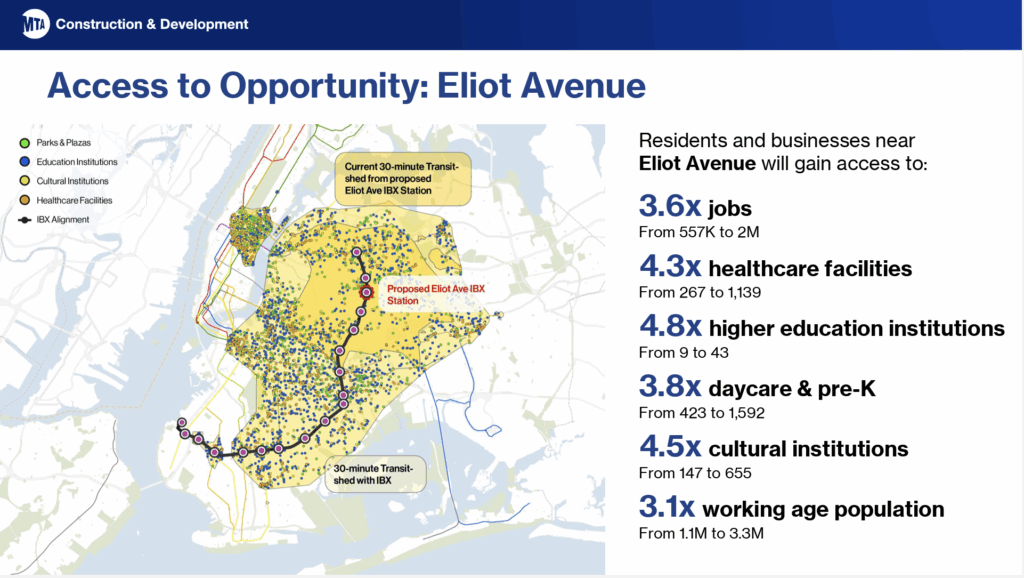
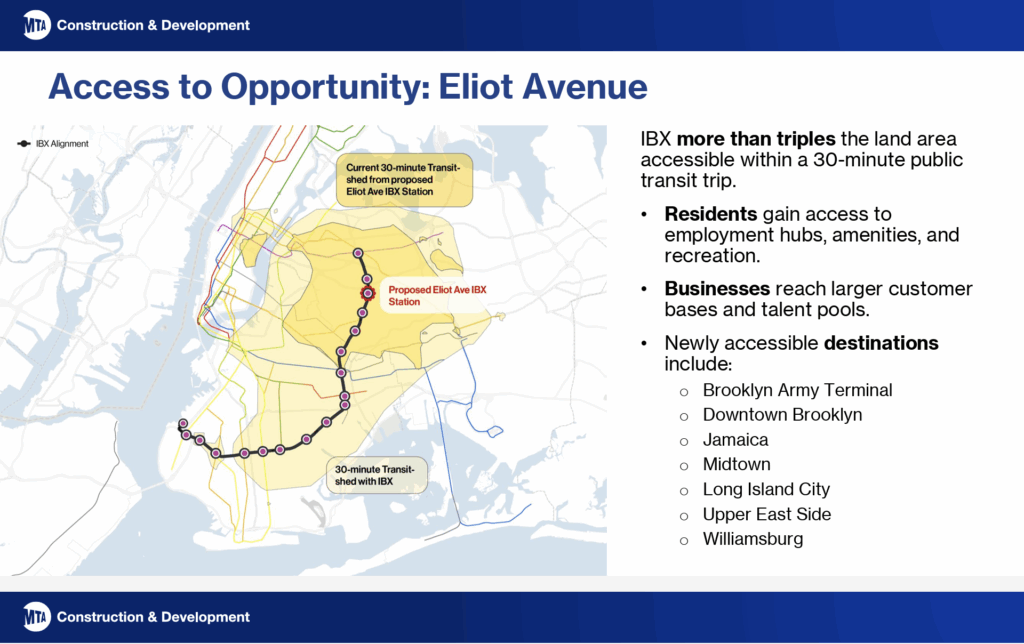
Senator Addabbo’s office set up a Zoom meeting between JPCA and MTA’s IBX team on April 23. The MTA presented the above slides, and we questioned their analysis.
For example, who is dragging a 3-year-old onto a subway to attend pre-K? That’s generally something near to one’s home. Where are the jobs centers along this line that would “open up” to residents? Where are the local jobs that others will be coming into the neighborhood to take?
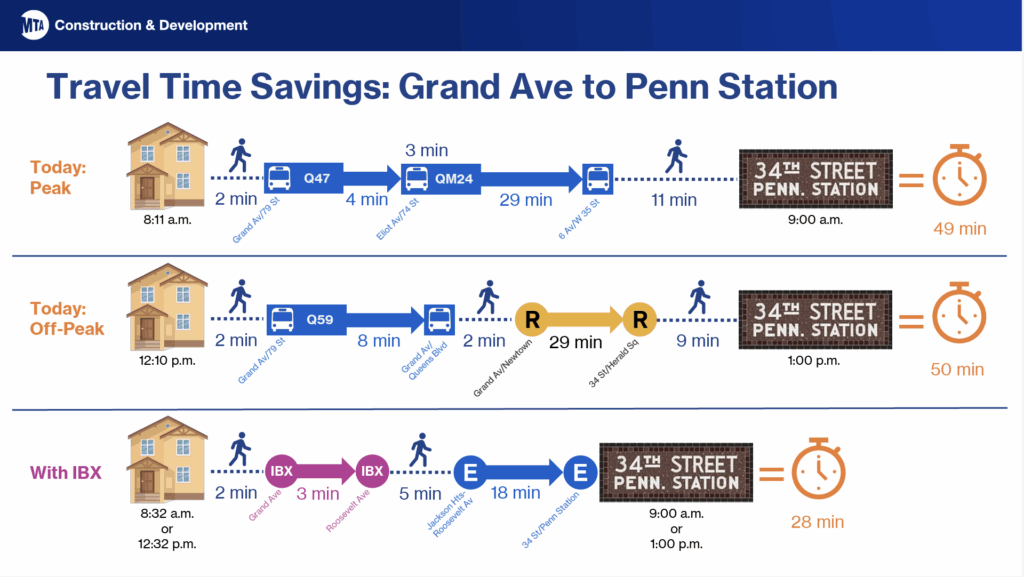
Much of the “time savings” alleged was dubious, including that people are taking local buses to express buses or staying on a local train to Penn Station instead of switching to an express. Members of the public who are in favor of the line have been critical of how many stops it makes and have asked if it should really be considered an “express”. Therefore, we suggested they remove Eliot and Grand from consideration and save a lot of money in the process.
The following questions were posed to the MTA’s IBX team after the Zoom meeting.
Q: Thousands of trees will be removed for this project. What are the plans to replace them? The just released NYC Urban Forest Plan indicates that Maspeth already has below average tree cover. The trees currently serve as a buffer between the polluting freight trains and the community.
A: We are studying the impact to trees in two ways: the environmental review analysis (Draft EIS to be released later this year) and an additional vegetation survey conducted by the design team (ongoing). These studies will quantify impacts. Our goal is to minimize impacts to the extent possible. Where there are impacts to public street trees, mitigations are highly regulated. MTA will work with NYC Parks and follow the guidelines of tree protection and replacement mitigation requirements.
(Public street trees are not the trees targeted for removal. Thousands in the right-of-way will be cut down.)
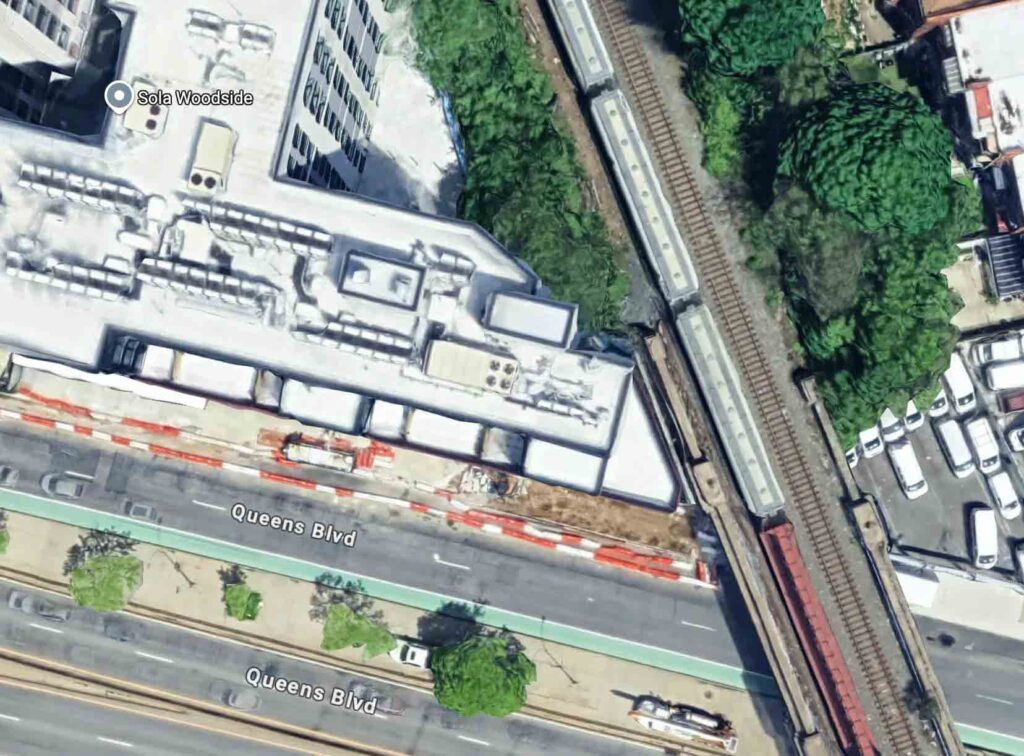
Q: Sola Woodside sits in the path of the track widening, so how will that be dealt with?
A: As part of preliminary engineering, the design team is currently conducting site surveys to understand the right-of-way and what property impacts will be. However, at this time, we do not anticipate impacts to Sola Woodside. Our goal is to minimize impacts to adjacent properties as much as possible. However, there may be a limited number of locations where portions of property are needed for stations, access points, or other infrastructure. When that information is known, it will be included in the Draft Environmental Impact Statement, which will be available for public review and comment later this year. Discussions with any impacted property owners will happen after that. If we determine that a property or portions of a property must be acquired, we are committed to fully complying with the Eminent Domain Procedures Law, Uniform Relocation Act and all applicable laws governing the use of eminent domain.
(The entire project would have to be shifted east to spare Sola Woodside, which would mean properties on the opposite side of the tracks would be affected instead.)
Q: How will a seamless connection at Roosevelt Avenue be made? The distance between the IBX terminus and 74-Roosevelt is too far to make commuting practical without a connector.
A: Our design team is currently studying how IBX will connect to the broader transit network. We recognize there are connections — including at Roosevelt — that are further than others. As we study these conditions and work with our agency partners, our goal is to make all transfers as clear and seamless as possible. We plan to preview these connections for public comment later this year, and we welcome more specific feedback on draft designs then.
(MTA previously stated that the terminus would be at Roosevelt Avenue and a direct connection to the EFMR7 trains at 74 Street would be too expensive.)
Q: The PEL report mentioned “NYCDCP has indicated its support for a mixed-use residential/commercial development at the current site of the Metro Mall, taking advantage of the existing M train service and the potential service connections provided by the IBX corridor.” Where else has DCP indicated to MTA that they will rezone?
A: IBX will not automatically trigger rezoning anywhere along the corridor. The City may choose to look at existing zoning districts along the corridor and pursue a rezoning strategy at areas that make sense. If that happens, it will not be led by the MTA, and will follow a separate public engagement process led by the Department of City Planning.
(We didn’t ask about automatic triggers for rezoning, we asked which parcels they discussed with the Dept of City Planning for rezoning, since MTA mentioned DCP was interested in rezoning Metro Mall in their own report.)
Q: Will the line run on union labor, and will it take advantage of one person train operation, or will it be automated?
A: Questions regarding train operations have not yet been determined, as we are currently focused on design of the corridor and selecting the appropriate vehicle based on corridor design criteria. Issues regarding operational characteristics, such as those you mention, will be clarified as the project moves further along. Additionally, we are currently speaking with manufacturers to choose the most state-of-the-art vehicles for the IBX.
(How do you design a train line and choose rolling stock without knowing what its operational requirements are?)
Q: How were the ridership numbers determined? Are they based on current population or projected growth after rezonings? How many people are expected to enter and exit at the Grand and Eliot stations?
A: The 18 stations that are currently part of IBX were selected to balance a number of factors, including constructability, spacing, usage and connections to other MTA services and arterial roadways. The MTA then applies its forecasting model, which is based on population projections developed by the local municipal planning organization (NYMTC). All of these elements are important for IBX to be successful and for MTA to build an overall system that meets its mandate to connect people to transit opportunities.
(When it was pointed out that the question about ridership at Eliot and Grand wasn’t answered, we received this response: We don’t have ridership information by stations available at the moment, but we will be happy to share this information with you as soon as we do. We don’t understand what this answer means. One would think they’d project the ridership at each station and then add the numbers together to get the total, which somehow went from 88,000 when the line was first announced to 160,000 now.)
Q: How much noise from construction will residents in proximity to stations have to endure and for how long? What will be done to prevent property damage?
A: The extent and nature of, and mitigation to construction impacts will be identified in the Draft Environmental Impact Statement, which is expected to be released later this year. If mitigations for construction noise are necessary, they can include temporary noise barriers, limiting construction hours, and use of low-noise machinery.
When the draft environmental impact statement is released, we’ll analyze it thoroughly and provide an objective analysis. MTA has promised more opportunities for feedback before then.
Is this really an option?
I asked the MTA to calculate an IBX route from a house near Frontera Park, which is in the “transit-oriented development” area defined by City of Yes, to see if it would save time on a commute to the 42 St-Grand Central subway stop. The best current option is ~40-minute ride on the Q67 switching at Hunterspoint Ave in LIC. This is what they came up with:
“From Frontera Park to Grand Central, you would have two IBX options with travel times similar to your current 40–50 minutes. One option is about 46 minutes with two transfers (Q58/Q59/Q98 to Grand Av IBX, IBX to Roosevelt Av, then the 7). The other is about 50 minutes with one transfer (walking to the Grand Av IBX station, then taking IBX to Roosevelt Av, and the 7 to Grand Central).
Based on your address, you’re about a 20 minute walk from the proposed Grand Avenue station and roughly 15 minutes from the Eliot Avenue station. Given that distance, IBX would serve as an additional travel option that’s comparable to your current commute. The largest benefit will be for those who live directly next to the new stations, as they will see the most significant improvement in travel time and convenience.
However, you would still benefit from having another reliable option. IBX will run every 5 minutes, 24/7, offer more capacity than existing bus service, this is especially helpful during offpeak times or when other lines are crowded.”
Why would someone opt for a 2-transfer ride and a long walk when they could just take one bus directly to the subway? Riding the IBX would mean a lot of people going opposite their direction of travel to board. It doesn’t seem to be a good option for the majority of Maspeth or Middle Village. Why does the MTA assume that building this line will translate into extensive use by a majority of commuters? Why would an area that requires a 15-20-minute walk to the IBX be a candidate transit-oriented development?