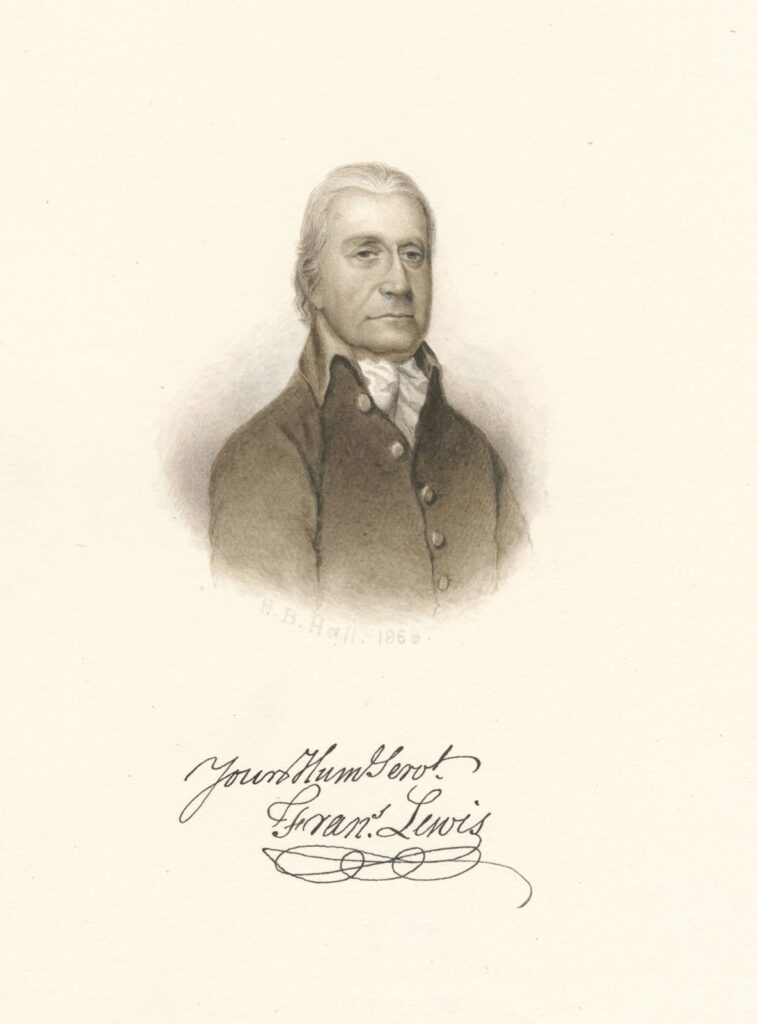
Francis Lewis
Francis Lewis was born in Llandaff, Wales. Raised by his aunt, he was educated in London at the Westminster School. He arrived in the colonies as a merchant, selling goods in New York and Philadelphia. He would travel the world to sell or acquire inventory – but made New York his home.
During the French and Indian War, Lewis supplied uniforms to the British. But while completing a sale, he was imprisoned by France’s Native American allies. The French took him to France, where he remained a prisoner until Britain’s victory in 1763.
As compensation, the British government granted him 5,000 acres of land in New York. But this did not secure Lewis’ loyalty: he soon earned a reputation as one of the most committed political radicals in New York City, helping to organize the city’s protest group, the Sons of Liberty.
By 1774, Lewis was a member of the Committee of Fifty, which effectively ran New York City, and when the Continental Congress was formed in the Fall, Lewis was a delegate. On August 2, 1776, he signed the Declaration of Independence.
That same year, after the Battle of Brooklyn, the British attacked the Lewis home in Queens, destroying books and personal papers, breaking furniture, and arresting Lewis’ wife Elizabeth.
Later, Lewis signed the Articles of Confederation, and continued to serve in Congress until 1779. He also rebuilt his mercantile business with his son as his partner. His old age passed peacefully, in the company of his books and his grandchildren. He died in December 1802, aged 89.
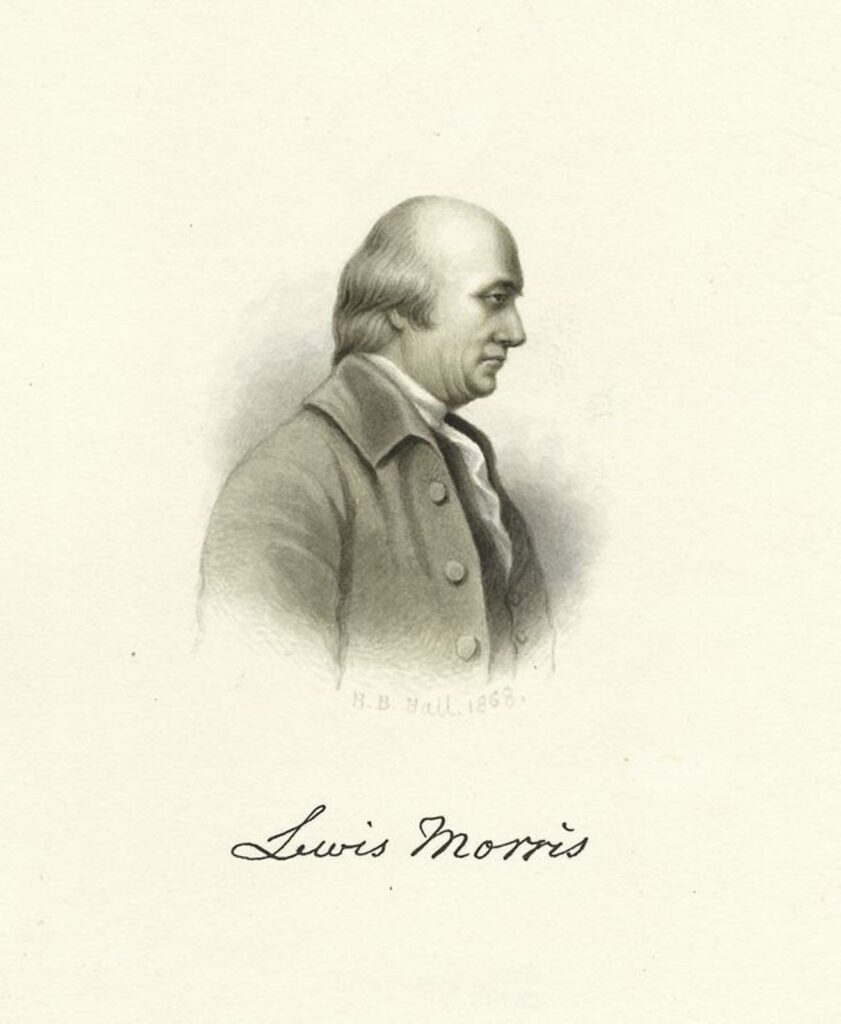
Lewis Morris 1726-1798
Lewis Morris was born in the manor house of Morrisania, a sprawling New York estate. He graduated from Yale and became Third Lord of the Manor Morrisania at 36. He was appointed a judge of the royal Court of Appeals in 1760 and took his seat in New York’s colonial assembly in 1769.
Over the course of the 1760s, as Britain revamped its colonial policies and began to impose novel taxes and regulations on the colonists, Morris became increasingly critical of the Mother Country. In 1774, he resigned his judgeship in the royal Admiralty Court and began an active role in the New York Convention – which was essentially the government of New York.
Although many of his wealthy neighbors remained loyal to the Crown in the 1770s, Morris had made his choice: he would support resistance to British policies. As a delegate to the Second Continental Congress, Morris was assigned to an important committee dealing with the supply of arms to the continental army. The congress then sent him to the western frontier, to persuade Indigenous Americans to either support the colonial cause or remain neutral if war with Great Britain began.
Though Morris was ready to see the colonies separate from Britain, the New York provincial assembly did not agree until July 1776. After signing the Declaration on August 2nd, Morris continued to serve in the Congress, until his brother, Gouverneur Morris, replaced him.
The British invasion of New York left his beloved Morrisania in considerable ruin, and when peace came, Morris devoted much of his energy to restoring it. But he made time for duties as a judge in Westchester County, and twice served as a state senator. When the New York convention met to ratify the Constitution, Morris voted in favor. He died in 1798, aged 71.
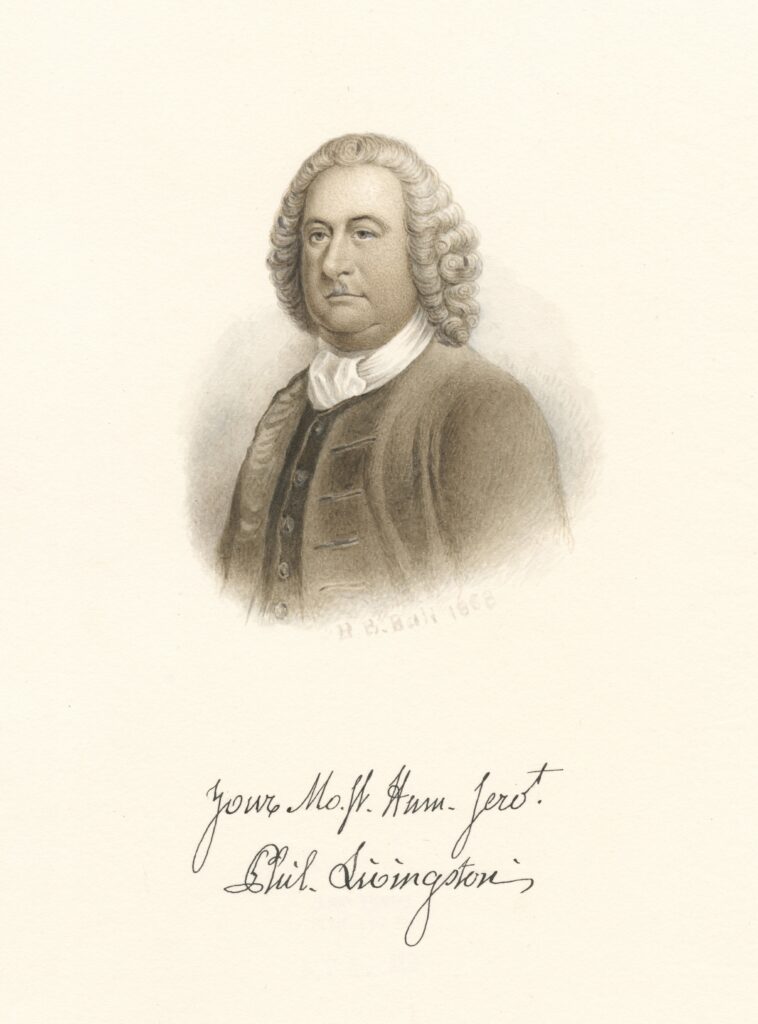
Philip Livingston 1716-1778
Philip Livingston was born in Albany, New York, to a large and influential family: his cousin (Robert) would also sign the Declaration of Independence, and his brother (William) would become the first governor of New Jersey.
Livingston went to Yale College, and on graduating began an apprenticeship with his father a farmer and merchant. Later, he helped found King’s College, and endowed a Professorship of Divinity at Yale.
He entered the New York political scene in the 1750s, serving as an alderman for the East Ward of New York City, and a delegate to the Albany Congress. Beginning in 1759, he served in the colony’s provincial assembly, and became its Speaker in 1768.
In 1774, he agreed to represent New York at the Continental Congress, and once the Declaration of Independence was approved, he signed it on August 2nd, 1776.
When the war with Britain came to New York City, Livingston’s Manhattan residence was used as a barracks, while his Brooklyn estate was turned into a Royal Navy hospital. His family fled to their home in Kingston, but as punishment for allowing the New York state constitution to be written and adopted there, the British burned Kingston to the ground.
At the first meeting of the new legislature created by this constitution, Livingston was a senator. Despite poor health, he continued to serve in the Continental Congress, and died in June, 1778, of what the 18th century called ‘dropsy’.
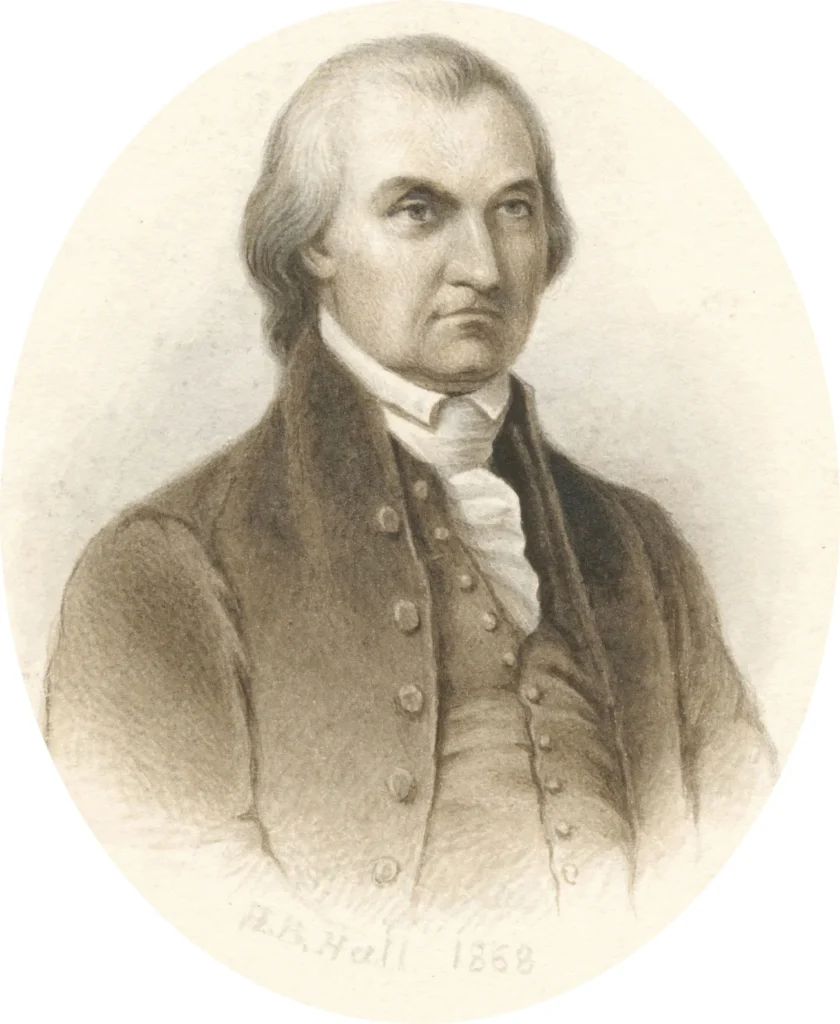
William Floyd 1734-1821
William Floyd was born in 1734, into a farming family in Long Island. Though he appeared to have no serious education, he proved an excellent farmer and account manager. The prosperity of his farm provided Floyd with entry into local politics: he served three elected terms as a trustee of Brookhaven and was an officer in the local militia.
Floyd was elected to serve in both the First and Second Continental Congresses, and though he rarely spoke during debates, he attended reliably. As soon as he was given his state’s approval, he signed the Declaration of Independence.
After the American army was defeated in the battle of Long Island, Floyd’s house and farm were confiscated by the British. Floyd took leave from Congress to try to retrieve some of his possessions, but the farm remained under British control for seven years.
Floyd continued to serve in Congress until the end of 1776 and became a member of the New York State Senate from 1777 until 1788. A year later, he took a seat in the First Congress under the new U.S. Constitution. He was a presidential elector for New York in 1792 and voted for George Washington for a second term in office.
Floyd died at the age of 87 on August 4, 1821, leaving behind an estate that included six enslaved people and two free Black servants in residence.
To read about all the signers, visit constitutioncenter.org/signers