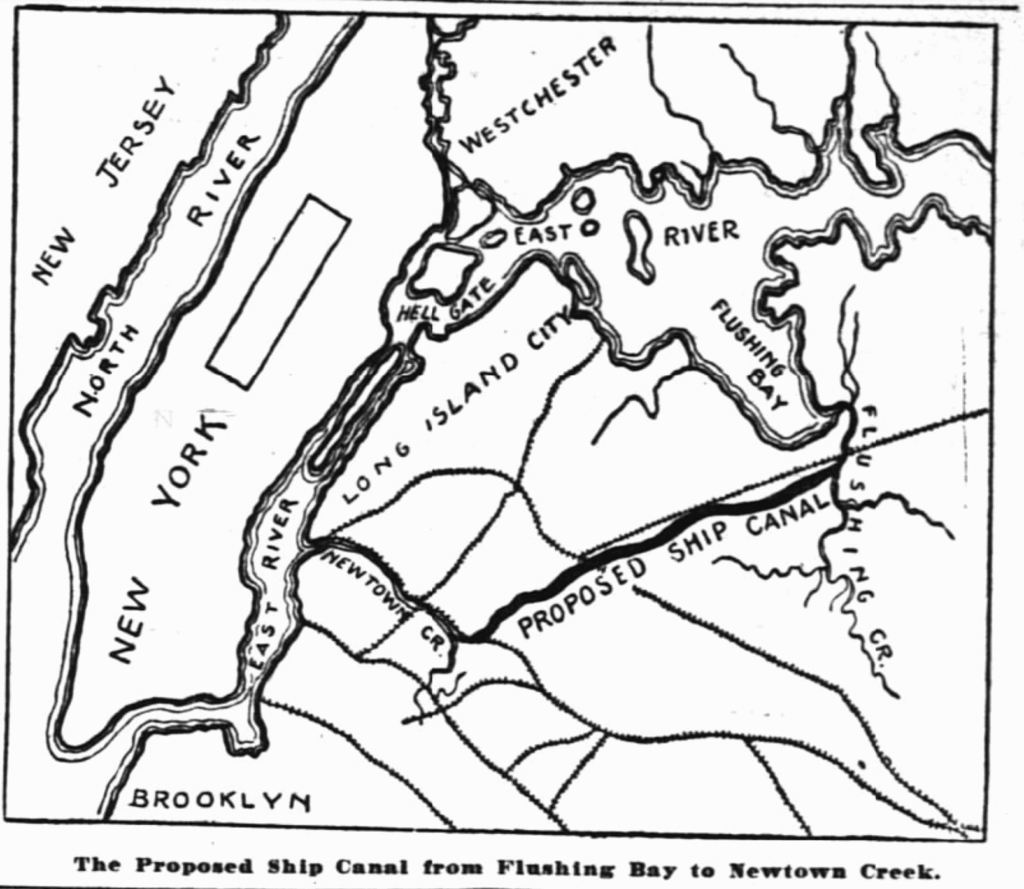
The Suggestion by Him to Extend Newtown Creek to Flushing Bay
by this truly great man that set the old-time Knickerbocker farmers to thinking and finally realizing to the present benefit to all New Yorkers. So when De Witt Clinton built the handsome and spacious mansion at Maspeth, near the creek, he began to study the topography of the town land, and in so doing set the dull-headed, liberty-hating old curmudgeons who owned it to looking with eyes askance at their meddlesome neighbor, who had, vulgarly speaking, “land on the brain.”
Gov. De Witt Clinton, strange as it may appear to readers of these modern times, was not – at least with a large portion of the people of Newtown—a popular man. He was too energetic, patriotic, and progressive a statesman to suit the slow-going, British gold-worshiping people who tilled the rich soil of Newtown and grew rich in a manner that was considered honest.
A man so active and enterprising, who hardly knew what repose meant to body or mind, who was always on the lookout for developing probabilities from seeming impossibilities, who made his native state the “empire” one of the Republic, was a surprise to those who resided near the shores of Newtown Creek. They could not understand him and his innovations. It was true, in the face of much opposition and to the discomfiture of the old Federalists and Tories, he succeeded in getting the people to consent to the cutting of a navigable ditch that permitted the waters of the great lakes to flow peacefully to the Atlantic coast and mingle with the tidal waters; but what on earth, thought the people
of Maspeth and of Newtown, did he want cut a like ditch, years before, to that of the Erie Canal from the head waters of Newtown Creek to Flushing Bay? This was in 1816. De Witt Clinton had been Mayor of New York, a city which he served faithfully, if “crankily,” as many declared, introducing improvements that are of value to its inhabitants even at this late day.
He was the originator of its sewerage and sewer system and was at his insistence that the upper part of Manhattan Island was laid out into streets and avenues “whose lines were parallel to each other.” Many other suggestions were made.
He was their bête noir. They opposed the projects “tooth and nail” and they had the satisfaction of partially ruining themselves by their shortsightedness; for, had Clinton succeeded in opening his projected watercourse, making it navigable for the larger seacraft of his time—vessels of 600 to 800 tons—he would have made that township the center of great industrial interests – in fact, much of the populations which make up the present great cities of New York and Brooklyn would have been drawn to it. Perhaps, through it, Newtown and Flushing would have been the sites instead of Brooklyn for the third city in population within the Union.
To many, this idea, at this time, will seem preposterous. Newtown Creek was, in 1810, and even later a different watercourse from what it is today. Now for the most part the channel is comparatively shallow. The dumping of dirt into the swamp that once extended along the upper part of the creek has had a tendency to raise the bed considerably. Fifty years ago, and even less, vessels of light draught could go up as far as the bridge without the slightest difficulty. A tugboat in this day in pushing its way from the mouth of the creek to the bridge stirs the mud at a lively rate, and sometimes it will run into a bank of earth that has collected at some projecting point that has not been cut off by recurring rains.
Of the importance of Newtown Creek in the beginning of the Revolutionary war and of its navigability this may be said: An old Quaker lady, residing in Maspeth, dying there about eighty years ago, told the writer that when she was a child (she distinctly remembered it) the British man-of-war Asia sailed up to the Penny Bridge and there cast anchor, remaining for some considerable time, purchasing supplies from Tory sympathizers; that the crew of the Asia were permitted to wash their clothing on shore, and the surrounding fields were, at times, whitened by their shirts and other underclothing which they there bleached. And, further, for many years subsequent to our last war with Great Britain, Penny Bridge was regarded as a rendezvous for gunboats.
Clinton sought to carry his suggested channel through to a creek that runs into Flushing Bay, believing it would prove to be of great advantage to the Island. Only a little rise of ground separates the streams, and the cut would have been less than a mile. Among the bitterest opponents to Mr. Clinton’s scheme was the owner of a grist mill on the creek near Flushing. It was a Tory mill, known as Johnson’s mill, and was his patronage. The mill was destroyed by fire in 1865.
Personally unpopular De Witt Clinton was at Maspeth because of his daring innovations and his largeness of spirit and disinterested enterprise. Although denounced as a monopolist and advocate of the canal to enrich himself, he succeeded in effecting one thing. It was this: He managed to introduce the modern plow. But he had to employ a little cunning to effect it. Until his time at Maspeth and indeed on all Long Island the farmers plowed the soil as their fathers and their father’s fathers did for generations before them, namely with a single stick and a mold board. Of course, the work was but a scratch. Subsoil plowing was unknown. Governor Clinton well knew that if he were to urge the farmers to adopt the iron plow with its share they would suspect there was something wrong about it and refuse even to look at it. He quietly put the plow on his own grounds and with a skillful handler of it cut furrows that were deep and straight and wide and these could be seen by the people passing along the highway. Their astonishment was great, inquiries were made. In a few years and to their entire advantage, the great statesman of the “Empire” Commonwealth, its future governor for three terms, and the builder of the Erie Canal, had the satisfaction of seeing the modern contrivance plowing the lands of nearly every agriculturist in Newtown, Bushwick, Williamsburg, and other townships.