“The Old Pond”
An old pond
A frog jumps in
Splash!
(Silence)
by Matsuo Bashō, 1686
That’s it. The wisdom of this haiku is in its simplicity. It’s just the raw experience. No added story.
Considered the most famous old Japanese haiku, this may also be the secret to a more peaceful life:
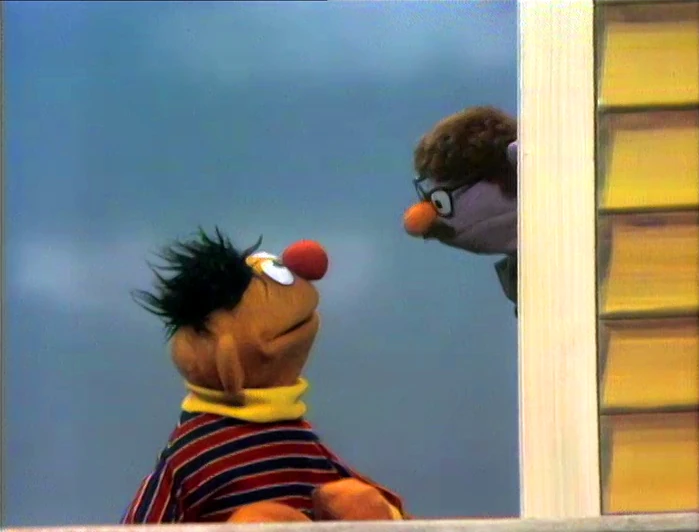
A skit on Sesame Street years ago, I would inadvertently watch along with my toddlers… (Didn’t we all?) … began with Ernie’s vacuum cleaner breaking when he needed it to clean his house. He decided to visit his friend Herbert Birdfoot, skipping merrily all the way over, to ask to borrow his. On the way over, he thinks out loud, we, the audience, are privy to his thinking:
Ernie:
‘Herbert’s a good friend, I’m sure he’ll lend me his vacuum cleaner.’
Then we hear his thoughts change:
“Or maybe he’ll think I won’t give it back and will say ‘No! Now THAT makes me mad! — If my best friend won’t lend me his vacuum cleaner!”
He knocks on his friend’s front door, and as Herbert opens it, Ernie shouts that he should “just keep your stupid, old vacuum cleaner!” You and I listening, like a fly on the wall, can see that Ernie’s anger came from what he was thinking.
But he couldn’t. His thinking made him furious. No facts there. Just his thoughts. The facts are simply:
Ernie’s vacuum cleaner broke.
He walked over to his friend Herbert’s house to ask if he could borrow his.
That’s it!
No angst.….
*These days I could certainly use more peace!
We are often unaware of how much tension comes from being caught up in the story we’ve made up in our head.
A possible made-up story might be: “It’s not a tale about a heroic frog looking over the water with trepidation, taking a few steps back, then making this courageous jump with the sun glimmering over the water, the flamingos clapping, and landing a perfect 10 Olympic dive.” (quote of Corey Muscara).
Just being aware that the thought in your head is, well, – just a thought. And ‘the thought of your mother is not your mother’, is freeing. (Joseph Goldstein, of the ‘Ten Percent Happier’ app.)
Just the awareness can be like a reset button. When you see that your story is one you made up, you also see that you have the choice to change it.
There’s a difference between being aware of the story in your head and being lost in it, believing it’s true.
The freedom comes from the awareness that you made it up. So, then you can break free of it. Know that you can make up another, a different story, a better version for you. Step back from what you’ve identified as our own story. Instead of believing it to be true and immersed in its upsetting scenario, see that you made it up. And that awareness frees you to change it.
Think, …hmm…
maybe! or,
maybe not.
‘Imagine if we experienced our lives, some of the time, anyway, as this haiku’ (Muscara),
– just the bare facts…
Try making a haiku of the next difficult moment you’re in