Feats of Elmhurst Hero Described in U. S. Air Force Release
An Eighth Air Force Liberator Division Headquarters Station, England — (Delayed) — Deep dusk enveloped the island “aircraft carrier” of Malta. Five more minutes and they never would have found it. The weary, crippled Liberator had flown for the incredible time of two and a half hours on one pair of motors.
Probably the real climax came when the agonizing homeward crawl that one battered plane flew all that time over enemy territory without any means of defense for hostile fighters, having thrown everything overboard that wasn’t nailed down in order to lessen the weight and enable the big bomber to maintain altitude.
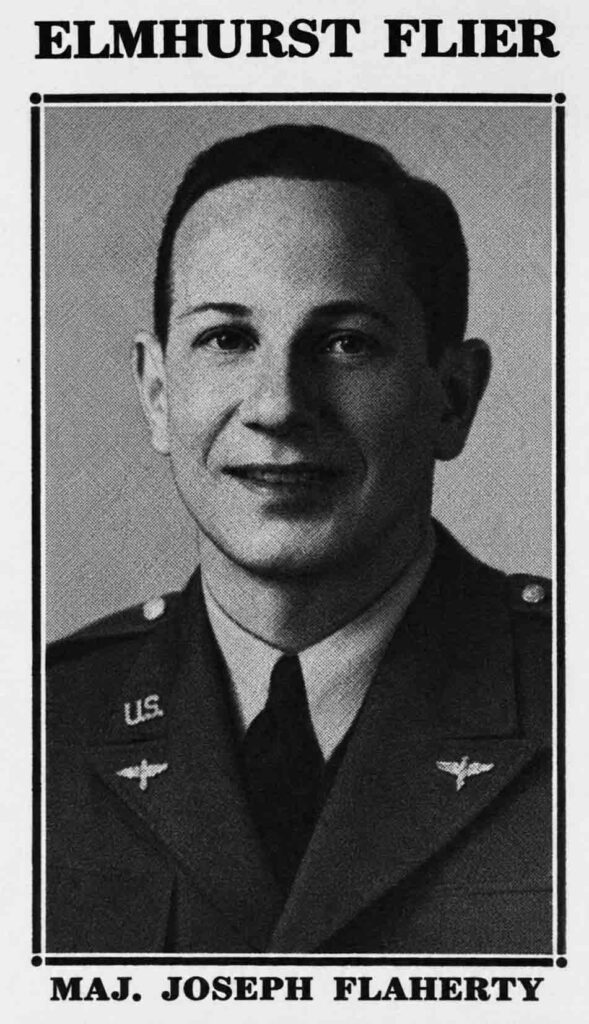
The skipper of the prize crew was 27-year-old First Lieutenant (now Major) Joseph St. Flaherty, of 5140 Simons St., Elmhurst, N.Y.
(Major Flaherty is the son of Mr. and Mrs. Edward Flaherty, who reside in St. Bartholomew’s parish. He is married to Miss Anne Reilly, a graduate of St. Joseph’s College for Women, in 1942. He is a graduate of St. Bartholomew’s school, Regis High School in Manhattan, and St. John’s University, where he was regarded as one of the outstanding all-round students in the college. He was active in sports, dramatics, literary endeavors and social clubs as well as a student of merit. He discontinued his studies to join the Army while in St. John’s Law School.)
He is of average height, compactly built, a wide Irish smile constantly covers his face as he relates the harrowing escape from death. A veteran of close to thirty missions behind the controls of the B-24 Liberator “Queen Anne,” named after his wife Flaherty … seen action in the Middle East … North Africa … and from British bases.
Limps in on Two Motors
This was his eighteenth bombing trip … the attack on the airdrome at Crotone, Italy. He was flying with the Eighth Air Force Liberators temporarily based in the Middle East to help pave the way for the Sicilian invasion. “Queen Anne” caught a hail of flak that totally disabled two
engines on the starboard side of the four-engined bomber. With the plane dragging on one side, “I had to keep my foot practically tied to the right rudder pedal, keeping the Lib on even keel,” the young pilot explained.
“We flew for what seemed to be a long time over the Mediterranean with the plane rolling from one side to the other while I continued pressing my foot down with all the pressure I could exert. When we finally reached Malta and landed, the crew jumped on me, pumping my arm until it was as sore as my right leg.”
Cited for “extraordinary achievement” in skillfully maneuvering and handling his aircraft, the Elmhurst flier was awarded the Distinguished Flying Cross.
“Flats” as he is known by his sky-riding comrades, with an eye toward a legal career, left the study of his law books to enter the service. “I got in the infantry. After one year of ‘foot slogging,’” he remarked, “I decided I’d rather fly than walk.”
His flying saga began when his group of Liberators flew from the States non-stop to their new British base in September, 1942, prepared to take up day bombing alongside the R.A.F.’s night technique.
His first chance to get a crack at the enemy was a medium penetration into France, the German air maintenance depots in Romilly-sur-Seine. The green combat crews rose to the occasion with stubborn youthful resistance… flying without fighter escort.
The boys made contact with the highly lauded German Luftwaffe … and after numerous engagements, the “Abbeville Kids.”
His first decoration, the Air Medal, for “meritorious achievement,” was presented to him after the wheels of his Liberator touched the landing strip on the return from an attack on the sub-pens and docks in Wilhelmshaven, Germany. “Queen Anne” hobbled in with evidence of her encounters with flak and fighters.
“But remember,” Major Flaherty remarked laconically, “the ‘Queen’ destroyed two Jerries and annexed a probable.”
Has Many Decorations
Major Flaherty is thrice decorated with the Distinguished Flying Cross, Air Medal with three Oak Leaf Clusters and two Distinguished Unit Citations, which he wears for participating in his unit’s epic low-level attack on the Ploesti oil refineries in Rumania, and the bombing of Kiel, Germany, on May 3, 1943.