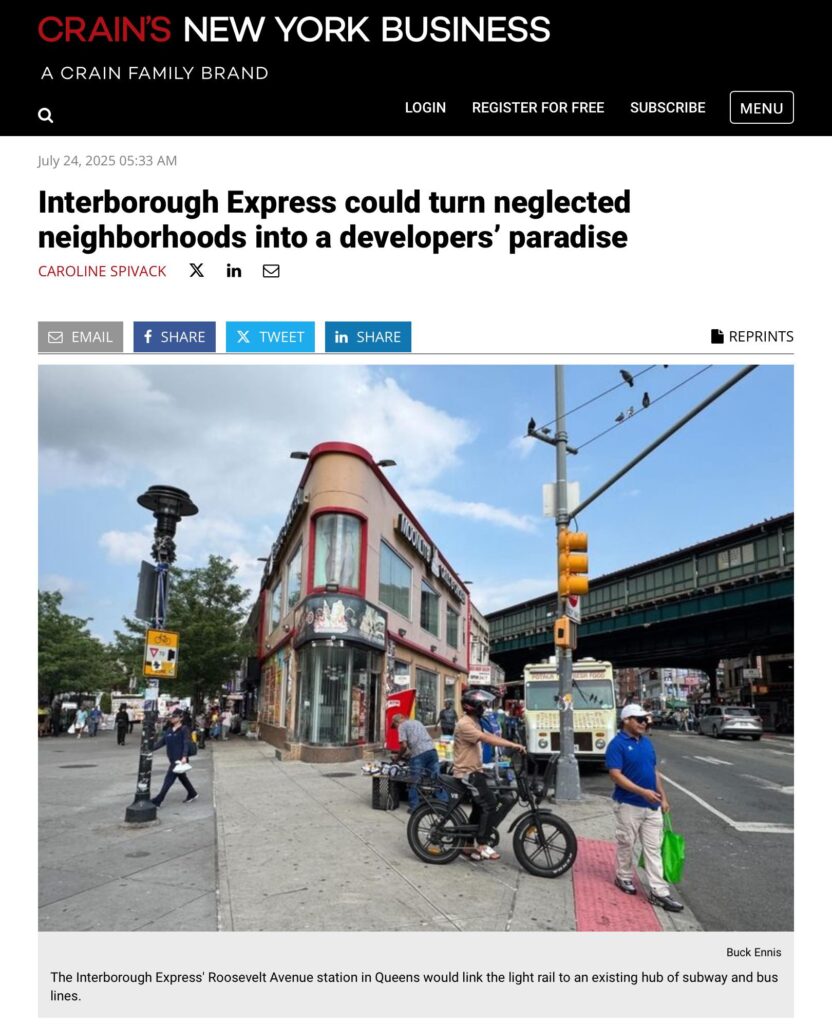
Earlier this year, Gov. Kathy Hochul descended to the tracks of the planned IBX light rail line to announce funding for an engineering and design study which coincided with a flurry of articles being released in various publications talking up how the building industry was rubbing its hands together in anticipation of a construction bonanza. It very disturbingly seemed to be focused on our area.
During her press conference, Hochul said, “This is a big change, it’s gonna be disruptive, we get that. This is why you bring in the community this early in the process. You’ve had open houses, hosted pop ups, met with residents and business owners, because you have to build trust and communication to make sure this is ultimately successful with community buy-in.”
Funny you should say that, Kathy, because all of this is being determined behind the scenes, without the input of the people who live here.
The MTA was quick to engage our communities for the Queens Bus Network Redesign, but now that they want to place three light rail stops here, they suddenly don’t seem to know where Maspeth or Middle Village are. Since 2022, MTA has held community engagement sessions in select neighborhoods that they believe will be enthusiastic about the light rail, but not one here – until November 19, which is AFTER they took comments on the record on November 6. Those who made the effort to attend meetings held in other communities found that organizers offered no answers to questions, claiming they were in the process of studying the details, while lobbying groups such as Riders Alliance and Transportation Alternatives sent their members to monopolize the conversation and skew the feedback.
Below are some unaddressed concerns:
Union busting: The day after Labor Day, a published analysis stated that the MTA plans to choose a contractor to run the IBX to exploit a loophole in the Transport Workers Union contract. If an MTA transportation system is run by a contractor, the TWU contract would not cover the workers. The TWU is opposed to automated operation, and MTA is considering that option to keep labor costs low. It’s likely that MTA chose light rail not because it’s the most efficient or cost-effective stock, but because it avoids union demands.
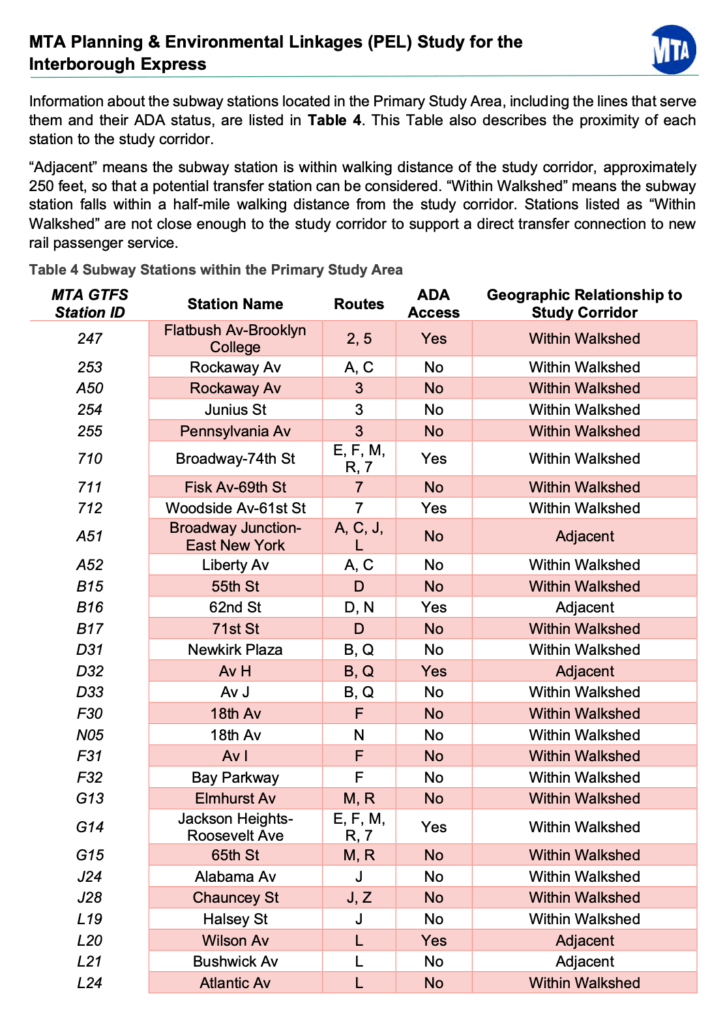
Lack of connectivity: MTA claims the line will connect to the E, F, M, R, and 7 trains in Jackson Heights, but the line will instead end 3 blocks away. From the MTA’s own report:
“Within Walkshed” means the subway station falls within a half-mile walking distance from the study corridor. Stations listed as “Within Walkshed” are not close enough to the study corridor to support a direct transfer connection to new rail passenger service…
So, 74 St-Roosevelt Ave Jackson Heights, listed as “within walkshed,” WILL NOT have a direct transfer from the IBX to the E, F, M, R, and 7 lines. I verified this myself by visiting the area and taking the following video:
How does this save the average central Queens commuter any time? Only 6% of commuters from our area are traveling to Brooklyn. The vast majority are traveling to Manhattan or elsewhere in Queens. Any time saved by taking the IBX up to Jackson Heights to catch a train will be eaten up by walk time. Many also would have to walk or take a bus opposite the direction of travel just to reach our “local” stations. Bus-to-subway connections will likely be more efficient for many. The Q14, Q18, Q38, Q47, Q58, Q59, Q67, and Q98 all make direct connections to the subway, without a hike.
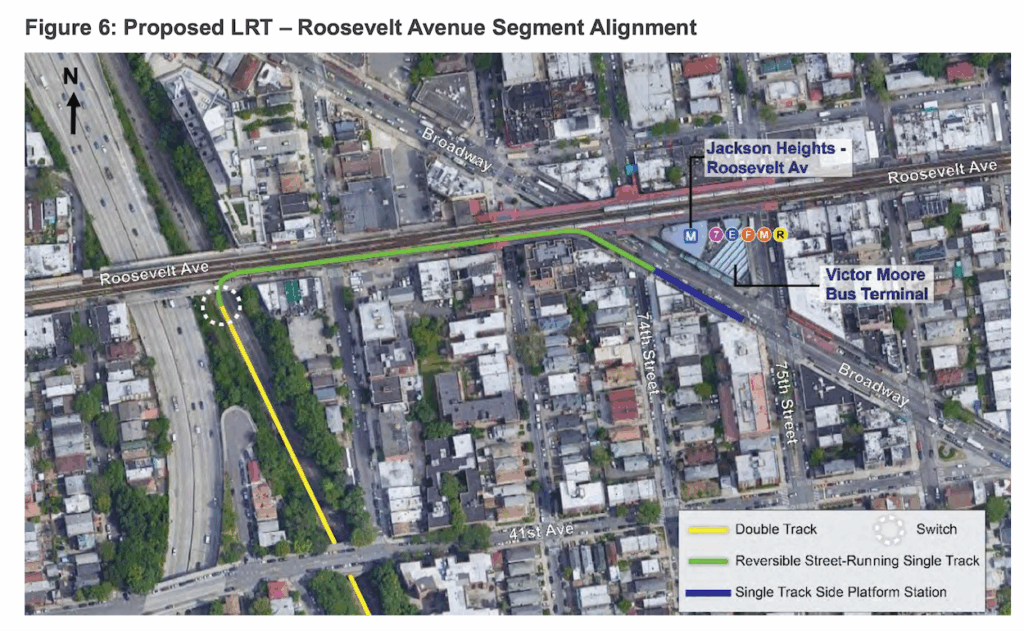
Graphic from MTA PEL January 2023 (MTA nixed this idea)
Per Gov. Hochul’s press release:
“[IBX] will create 19 stations and connect with 17 different subway lines, 50 bus routes and two LIRR stations.”
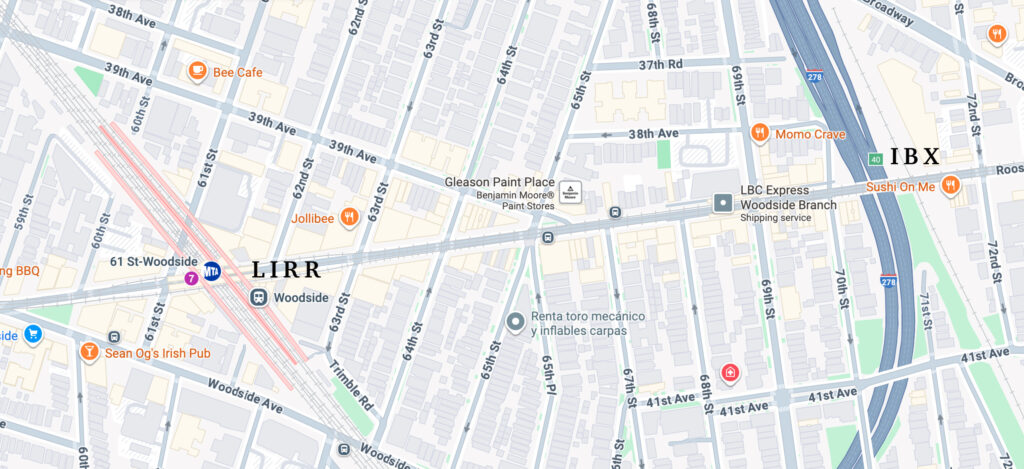
It will stop at the East New York LIRR station. What other LIRR station will it stop at? Woodside is listed as being “within walkshed,” but it’s more than 8 blocks away. Let’s get real, no one is doing that. There are no other LIRR lines that cross the IBX, so what is she talking about?
At the November 6 scoping session, Jordan Smith, the IBX project director, claimed the two lines were “only 2 blocks apart.” Oh really? I walked this as well, see video below.
Ridership: The first estimate was 88,000 daily Mon-Fri riders for the entire line. It was revised to 115,000 last year, now it’s 160,000. Based on what? They don’t even know how many cars the trains will have or what their capacity is yet. With the admitted inability to easily transfer, one would think the ridership estimate would go down, not up.
Property loss: Eminent domain is going to come into play. The MTA knows it will condemn a certain number of properties, but won’t specify where. To install accessible stations with elevators and ramps, they no doubt will have to condemn multiple properties adjacent to each proposed station. This was their answer when asked how many properties would be condemned:
Construction: How will this disrupt the neighborhood? How much noise will residents in proximity to stations have to endure and for how long? What will be done to prevent property damage from vibrations like what happened on Calamus Ave during the sewer replacement project?
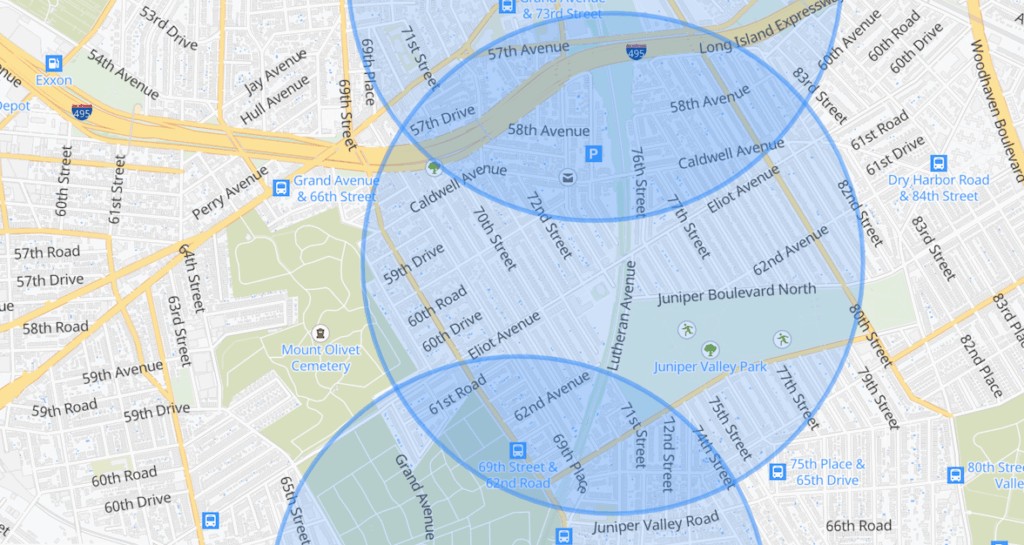
Affordability: We do not have a housing problem, rather we have an affordable housing problem. Yet we have the Dept of City Planning already announcing that they plan to upzone properties located within a .5-mile radius of each station (see map above) for market rate housing, with a larger number of units allowed near hubs, like Metropolitan Avenue. They have already told the MTA that they will change the zoning of the Metro Mall to allow for hundreds of units there. The New York Building Congress published a report detailing where their development targets were, and it coincidentally included a .5 mile radius around each stop along the line. That would bring development that would cast shadows over Our Lady of Hope, Juniper Valley Park, Elmhurst Park, and everyone who lives in a 2-3 story residence in those areas. The Shops at Grand Avenue, anchored by Stop & Shop, was also specifically mentioned as a redevelopment site.
Infrastructure: All this upzoning will put a strain on city services which are already lacking. We have frequent power outages, basements and roads flood, sewers back up, tons of CSOs end up in Newtown Creek, schools are overcrowded, we have a dearth of police, and cleanliness is lacking due to sanitation cuts. We aren’t hearing anything from the city or state governments explaining how these issues will be rectified, yet they want to encourage more people to live here which will exacerbate all these problems. This is a low-rise area, and we do not want to live in the shadow of tall buildings built for people who will gentrify the area and make it even more costly to own or rent here.
This is being framed as bringing “transit equity” to us, but there has been a concentrated effort by moneyed interests to spread the word that they plan considerable development along the line. We have always lived without rapid transit here, and now are being told that in return for getting a half-baked version of it, we’ll have to accept a transformation of our neighborhood that we don’t want. As someone who is reliant upon public transit most of the time, I was hopeful that this project would provide much needed connectivity to existing train lines and help us get around easier. But after examining the devil in the details, it’s clear this is a development scheme disguised as a transit solution and destined to be a boondoggle. Where are our state elected officials, who have a direct line to the governor as well as the MTA? All of them have either been silent or have given full-throated endorsements of this disaster.
After noticing the developers publicly licking their chops over the thought of running roughshod over our neighborhoods, AMNY published an editorial which concluded with this:
“Most of the new housing created along the IBX should be made affordable for the vast majority of New Yorkers. Residents in the communities where the line will run should be given preference. A neighborhood’s true character, after all, is built on the people living in a community rather than the housing stock itself. Anything less would defeat the purpose of the IBX: A transit link to bring more New Yorkers together, helping them get around the city they love faster and more affordably.”
Nice sentiment, but fat chance. There is no talk of this proposed housing being affordable or reserved for the people who already live here. That simply would not be profitable, and that’s what this is all about.
Our obligation as NYC residents is to obey the law and pay taxes. And in return, we are supposed to be served by our government, not replaced. We aren’t getting adequate services, meanwhile, our relatively affordable neighborhoods are in the crosshairs of developers who “transform” them for big bucks.
TO RECAP, IN THE PAST 5 YEARS, WE’VE HAD:
– Corey Johnson’s Planning Together
– Kathy Hochul’s Housing Compact
– Eric Adams’ City of Yes
– Eric Adams’ Charter Commission upzoning proposals
– The AirBnB bill which will allow every home to become a hotel
And now this.
If it seems like “they” are coming after our neighborhoods, that’s because they are.We’ve been here before. Without Federal and CSX approval, it seems as though MTA is spending billions of tax dollars that will result in studies and surveys by well-paid consulting firms, but no construction, just like the Cross Harbor Project.