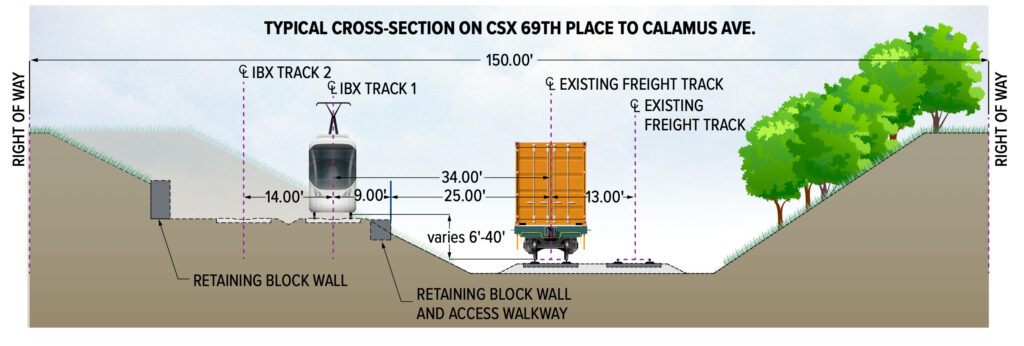
IBX construction and other impacts from the project would affect residents near the right-of-way for years. If it does build the IBX, the MTA has the opportunity to pair the changes in freight rail the IBX will require with the deployment of modern freight rail technologies and a new era of either LIRR freight rail operation or a new Transfer Agreement combined with dedicated LIRR supervision. Otherwise, the IBX project simply adds new burdens, and worsens current freight rail impacts and pushes them into more neighborhoods of NYC and onto IBX riders.
One of the ways the MTA can avert “unintended consequences” from antiquated and unsafe freight rail equipment and operations that already are predicted in IBX planning is by factoring into its decision-making new and higher standards for the freight operator, including the following:
Public Safety and Transparency: The New York & Atlantic Railway (NYA) has had a poor safety record compared to other Class III railroads per the Federal Railroad Administration’s 10 year Accident and Incident reports. A new operator must possess higher safety standards and performance. The LIRR needs to publicly and proactively disclose all freight and passenger operation derailments, accidents, and incidents, which is not the case today.
Financial Muscle: The operator must be a company that can field modern, EPA Tier 4 or cleaner emissions locomotives. NYA has never purchased or leased such a locomotive. In fact, with the exception of Waste Management’s KLW locomotive and the prototype PR20B’s purchased by LIRR, NYA has never used a locomotive that was built after the 1970’s.
NYA under the original Transfer Agreement was responsible for track and way maintenance on Freight Premises (Bay Ridge, Bushwick, Fresh Pond Yard and Freight Sidings such as Nichols), and later modified to include the entire Lower Montauk West as it was then designated. It was also responsible for grade crossings of the Bushwick Branch and later the entire Lower Montauk. There should be an assessment of all this trackage with a clear outline of responsibility and standards of upkeep for the new operator. As a corollary, the new operator should have an investment interest far and above NYA’s obligations, which can’t even be described as minimal.
ROW investments have come from public monies in the NYA era, even as adverse health, environmental, and quality of life impacts have increased, particularly from waste-by-rail. NYA may have begun as a railroad startup in 1997, when they signed the first Transfer Agreement with the LIRR. However, NYA has seen exponential growth in the waste-by-rail business, in which NYA owner Bruce Lieberman invested with Tunnel Hill Partners in 2008, in LIRR’s Farmingdale Yard (NYAR Coastal). Tunnel Hill eventually was bought out by international investor Macquarie because “the margins are quite attractive.” The public—which, for example, has subsidized below market locomotive lease rates and equipment sales to NYA, and paid for replacement and repair of bridges in the current era of Plate F high side C&D gondolas—should not be providing subsidies.
NYS & NYC Environmental Laws/Standards: Any new agreement should explicitly state the operator’s obligations to abide by NYS & NYC laws and standards. The Transfer Agreement has such a clause, however LIRR never enforced it, allowing NYA to hide behind the Interstate Commerce Clause. Any new operator must acknowledge and agree to voluntarily set aside any recourse to Interstate Commerce sanctuary where local and state laws and standards apply to freight operations on the public Right-of-Way, including the new law championed by Senator Addabbo and Assembly Member Rajkumar that mandates containment of waste-by-rail. As a Member of the American Short Line and Regional Railroad Association (ASLRRA), NYA is a party to a lawsuit — filed in federal court by the ASLRRA, Association of American Railroads, and National Waste & Recycling Organization, New York State Chapter — that seeks to overturn the NYS law mandating the modest public protection of solid covers for loads of C&D that went into effect in January 2024. C&D-by-rail is still covered only by pervious netting — and the cars also have floor drains. [United States District Court for the Southern District of New York, No 24-CV-135 (RA)].
Proper insurance requirement: NYA’s current policy requirements, unchanged since 1997, are on their face insufficient for the risks and potential damage that can be done. Bear in mind propane and low level radioactive soil are the two HazMat cargos carried by NYA, and the C&D it hauls in open rail cars is assumed to contain toxics by NYS DEC.
Conflicts of Interest: The MTA, including MTA Real Estate, must ensure that it is the public that benefits when companies lease property and operate in the MTA Right-of-Way. The right to negotiate the lease of space and receive compensation for it belongs to the MTA. This should be stated explicitly in the new Transfer Agreement, and not be delegated to a freight rail concessionaire. This averts conflicts of interest between the LIRR freight rail concessionaire’s freight operations and companies operating in the Right-of-Way, as seems the case in the Blissville coal ash operation. It also ensures that all legal requirements are met. If NYA and its parent Anacostia Rail Holdings (ARH) have been denied a chance to bid for a concession on or before the Transfer Agreement ends, ARH should not be allowed a contract with any vendor located in the MTA Right-of-Way, including the coal ash operation in Blissville Yard.
Freight Car and Freight Load Inspector: A dedicated LIRR employee needs to be assigned to monitor the waste car loaders (C&D/MSW/Shredded Vehicle) for overloading, improper materials (HazMat like asbestos, MSW in C&D cars, etc.) and certain defects such as dragging equipment and wheel flange wear. The inspector must have access to all freight train movements including those on freight premises. The inspector must have the authority to order spot checks on the car scale at Brooklyn Resource of suspected overloaded cars. The inspector must have the authority to enter any of the loader’s facilities, and deny movement of cars that violate tariff provisions. Improperly loaded cars must be unloaded and offending materials safely and properly removed. The inspector must be qualified and know freight operations. All C&D and MSW loaders must make available the geographic sources of their loadings. This is already a requirement of NYS DEC. It should be made easier to research. The commitment of a dedicated LIRR employee must reflect the LIRR’s actual status as the steward of this state property. The LIRR cannot disavow its responsibilities to oversee and supervise freight operations.
The constant refrain of how vital this Right-Of-Way is must be matched by LIRR’s supervision of the operator chosen to move rail freight upon it, particularly since freight operations impact passenger service, which in the future may include the IBX. The mistakes of the 1997 Transfer Agreement must be corrected. The 10 year extension in 2017 was a serious mistake. LIRR personnel then had knowledge of NYA practices that led to the discrimination lawsuit against NYA, and if the MTA conducted a thorough investigation, as it stated it would in an April 5, 2018 letter to state electeds, it has yet to make those findings available. It should do so now and NYA must be held accountable for acts determined to be improper and/or illegal. As a company, NYA has consistently used every argument to avoid facing problems generated by freight traffic and its own operations.
We wish to point out the 2015 Maspeth grade crossing accident, wherein it was determined by investigation that NYA was responsible for that grade crossing accident involving a tractor trailer. This is almost unheard of in rail transportation. The NYA locomotive engineer fled the scene, the FRA could not track him down and NYA claimed to not know where he lived. This incident prompted an intensive deep-dive FRA investigation into NYA. Congress Member Grace Meng had to intervene to ensure that report was made available to the public.
With the further burdens the IBX would bring, the MTA must address serious freight rail problems before 2027 when the Transfer Agreement expires.