Glow-ups Galore
I’ve seen my fair share of returns to glory in the gaming industry. I’ve talked about one such return with the Tomb Raider franchise but there are countless others. A few others that come to mind are the story of No Man’s Sky, Nintendo’s woes in the early 00’s and early 10’s, and Hideo Kojima’s rocky end of his Konami tenure. None have had quite the confluence of disparate entities or franchises that all converged on a single game.
Silent Hill f marks an important landmark for three such entities’ recovery. You have the franchise Silent Hill, the developer NeoBards, and the publisher Konami. Let’s run through these quickly, shall we?
Silent Hill’s story starts back in 1999 as an answer to Capcom’s successful Resident Evil series. It took a more self-serious, psychological tone compared to Resident Evil’s B-Movie schlock. The franchise grew a devoted following, up until Konami (coming soon) decided to disband the team behind the most successful entries. The IP was passed around various C-list studios before the franchise went dormant for many years.
Enter Konami. They were one of the highly respected game developers in the 80’s and 90’s with hits like Castlevania, Contra, and Metal Gear Solid. Around the early 2010’s their reputation started to dip. It all came to a head when they launched a demo titled PT on the PlayStation 4. It teased a new Silent Hill game helmed by none other than Hideo Kojima. That game never saw the light of day. Kojima was unceremoniously tossed out of Konami and the publisher decided to turn nearly all their beloved franchises into slot machines. That decade was a major low point for the franchise and the developer. It wasn’t until a few years ago when they finally turned things around.
This is where our last player, developer NeoBards, enters. They were a complete nobody since their 2017 inception. They worked on HD ports of older games to newer consoles and their only original title was a poorly received multiplayer game in the Resident Evil series.
It should have been a recipe for disaster. In my opinion Silent Hill hasn’t had a good game since 2003. None of the pieces seemed like they were going to click (the remake of Silent Hill 2 doesn’t count; I haven’t played it yet).
And yet… it’s quite good
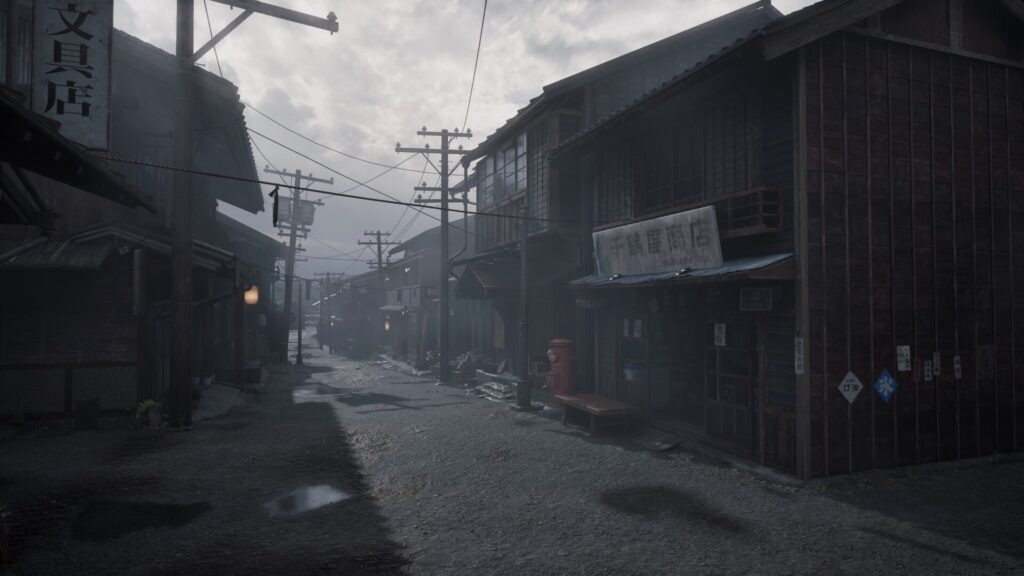
Silent Hill’s setting has most commonly been associated with the United States and Midwestern towns. The running joke is that Silent Hill and Raccoon City are right next to each other, and the monsters sometimes get the two towns mixed up. Not so in f. NeoBards moved things from the US to a rural village in 1960’s Japan. I know some critics were wary of this change, but it works shockingly well. There’s so much to crib from the era and location. Of course, I’m not Japanese. I can’t say for certain how accurate the finer cultural details are. What I can say is that this is the most existential I’ve felt while playing a video game.
The relationships between the protagonist Hinako, your love interest Shu, and a rival named Rinko are a centerpiece of the game. My favorite example of this is a puzzle where you’re tasked with opening a box. Different symbols festoon the box, and you need to look at letters from Rinko to Shu to figure out what the correct symbols are. These letters are both putting you down and showing how deep Rinko has her claws into Shu. It’s a fantastic example of storytelling combining with gameplay to create oppression.
Speaking of oppression, everything about the atmosphere of the town you’re in is masterfully executed. The trademark fog rolls over the town, blurring what’s ahead of you. Beings shamble through the streets. They’re mostly
mannequins—of women, of your classmates, reflecting how Hinako feels that she should be contorting to meet the standards around her. Sound design by series veteran Akira Yamaoka keeps up the tension, even when it feels like you’re safe otherwise.
What’s most novel about the visuals is the departure from the franchise’s proclivity for rusted corridors and corpses on the walls. Here in f everything is fungal, growing out of the walls and seeping into every part of the town. There are some particularly gruesome scenes later in the game which I won’t describe here out of considerations for spoilers and good taste.
The combat received a substantial overhaul as well. It’s more akin to modern games where you’re juggling health, stamina, weapon durability, and sanity meters. I understand the need to innovate, but I prefer the older games’ style of walking up to something and wailing on it until it dies.
I struggled a lot in this game, both when solving puzzles and killing monsters. Part of that is on me. I set the difficulty for both to the hardest. But what I would have liked is an option to turn down the difficulty later. The only way to make the combat easier is to die multiple times until the game decides to throw you a bone. And there’s no way to make the puzzles easier after you start. Something to keep in mind if you do decide to give this game a shot.
Silent Hill f received rave reviews from most outlets, and the sales were the strongest ever in franchise history. This has led to bigwigs at Konami to announce that they’d like Silent Hill to become an annual franchise. After such a long dormancy, I’m happy that we’re going to get more entries in the series, but I’m worried that the franchise will run itself into the ground.
For now, though, enjoy it while it lasts. Pick this game up. If you like survival horror, you won’t be disappointed.