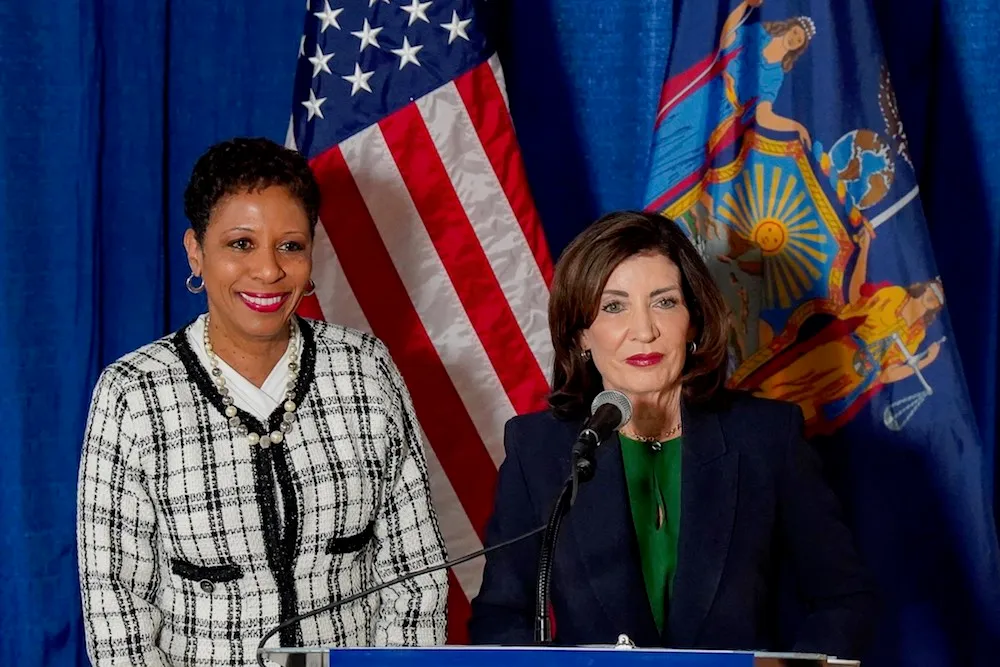
It wasn’t surprising that Gov. Kathy Hochul chose former NYC Council Speaker Adrienne Adams as her running mate for her re-election race this year. We’ve come to expect our Governor to make some very poor choices over her underwhelming tenure. We in the middle class suffer more than any group because of Hochul’s policies. New York taxes its residents more aggressively — 13.6% — than anywhere else in the country when it comes to income tax.
New Yorkers deserve leadership that puts public safety, fiscal responsibility, veterans, and everyday residents first. Let’s examine our governor’s latest political choice, Adrienne Adams as her running mate. Under Speaker Adrienne Adams, the City Council too often delivered ideology, retaliation, and dysfunction. Now that her term is over (thank God), it is clear her speakership will be remembered as one of the most damaging in city history.
I served eight years in the City Council with Adrienne Adams, including four years under her speakership. When we both entered the Council, she was a pragmatic, common-sense member focused on governing. That changed once she became Speaker. Power replaced principle, and consensus gave way to retaliation. By the time of my final Stated Meeting, that transformation was impossible to ignore, especially when Council leadership chose personal vendettas over doing the right thing and New Yorkers paid the price. That is not leadership. It is a lack of leadership.
Speaker Adams governed through ideology and internal politics instead of common sense. On public safety, the Council she led forced through sweeping criminal justice legislation over mayoral vetoes, including the so-called How Many Stops Act, new limits on how the city manages violent inmates in custody, and a requirement to turn over police body-camera footage to the Civilian Complaint Review Board in direct conflict with state law. These policies may have pleased activist groups, but on the ground, they buried police officers in paperwork, discouraged proactive enforcement, and stripped correction officers of tools needed to maintain order. At a time when crime and disorder dominated public concern, the Council weakened public safety instead of strengthening it.
Her approach to sanctuary city policy followed the same pattern. Sanctuary laws were treated as untouchable dogma, even as the migrant crisis overwhelmed city services and strained the budget. When certain Council Members signed onto a court filing supporting the opening of an ICE office on Rikers Island, she did not engage in debate. She retaliated. Their constituents were punished when capital funding for parks, schools, senior centers, and neighborhood projects was cut. Communities paid the price for political disagreement. That was an abuse of power.
Fiscal responsibility fared no better. During her tenure, the Council rejected even modest restraint while warning against austerity. There always seemed to be money for illegals, but never for veterans, retirees, or the basic commitments New York made to its own people. As federal aid dried up and budget gaps grew, ideology came before fiscal reality, pushing the bill onto taxpayers and the next City Council.
Nowhere was this failure clearer than in her treatment of veterans. One of her final acts was killing an important package of veterans’ legislation sponsored by multiple Council Members. These were not symbolic bills. They would have guaranteed veterans a voice through committees on every community board, expanded economic opportunities for veteran-owned businesses, reduced unnecessary burdens on veterans’ service organizations, and explored new ways to address service-related trauma.
This decision reflected a broader failure toward veterans throughout her tenure. While the Council expanded programs for others, veterans were again ignored. Instead of correcting that imbalance, she buried the bills and ran out the clock. The message to those who served was unmistakable: drop dead. It was not about cost. The bills were vetted. It was personal. Veterans became collateral damage in a political vendetta, as veterans’ initiatives remained flat year after year and organizations warned that posts were closing and services were disappearing.
The same pattern extended to retirees and public servants. She refused to move legislation like Intro 1096, which would have protected city retirees and preserved their Medicare coverage. Separate legislation to properly support and compensate paraprofessionals in our public schools met the same fate. These were not radical proposals. They were about keeping promises. Inaction was the choice.
Animal welfare legislation met the same fate, as broadly supported measures like Ryder’s Law, pet food pantries, and rodeo restrictions were quietly killed, not on the merits, but out of personal grudges.
As her term ended, the damage to the institution was unmistakable. The City Council became less independent, less deliberative, and less relevant. Decisions were driven by loyalty and retaliation rather than policy or principle, with taxpayer dollars used to reward loyalists and punish dissent, leaving entire neighborhoods to pay the price.
Adrienne Adams’ legacy is not accomplishment. It is mismanagement, retaliation, and deliberate misuse of power. When leadership was required, she chose inaction. When restraint was needed, she acted in ways that weakened public safety, sidelined veterans, punished communities, and hollowed out the City Council. After running a failed campaign for mayor, she now takes her corrupt clown show to attempt to give Kathy Hochul another 4-years to thoroughly run New York State into the ground.
Wake up middle class! If you think that ridiculously higher taxes, Congestion Pricing tax, City of Yes upzoning, Lithium-ion battery storage facilities in our neighborhoods, IBX, cutting public safety, higher energy costs and politics as usual are the way to go, then you probably drank the Hochul/Adams Kool-Aid.
Of which there is no known antidote.